How does a phone enable us to talk to people far away? (Part II)
The last article was all about landline calls and their functioning. Today, almost everyone in the world uses a mobile phone or cellular phone. Let’s see how cell phones work!
How can the voice be transmitted without using wires? A cell phone uses radio waves – it is a very sophisticated two-way radio! What is a radio wave? Like all electromagnetic radiation, a radio wave travels at the speed of light. A radio wave is a kind of electromagnetic radiation. The number of times per second that a wave vibrates as it travels through a medium (air, water, space), is known as its frequency. It is measured in a unit called hertz (Hz). The speed of sound is around 340 metres per second, but a radio wave can travel seven times and a half around the earth in one second! This speed makes it possible for our voice to cross great distances without any delay. The speed at which light and radio waves travel is 3,00,000 km per second.
Radio waves are used in a variety of electronic and electrical gadgets. Radio waves make wireless communication possible! Are mobile phones like walkie-talkies? How do radio waves work on a mobile? Do they jump between phones? No. though cell phones are like a two-way radio, the radio waves cannot jump directly from one cell phone to another even though they travel as far as the nearest cell phone mast!
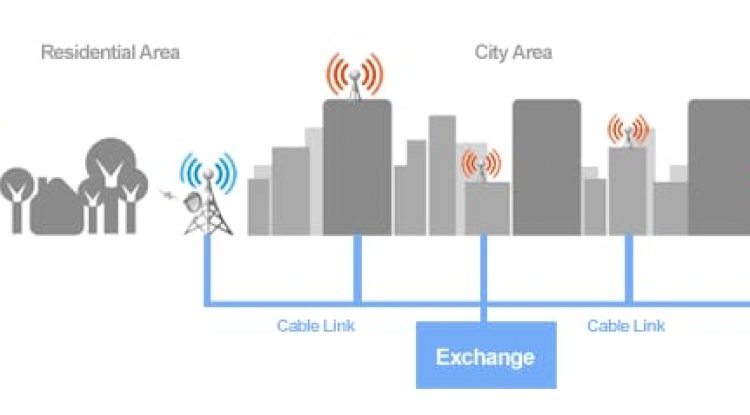
The word ‘cellular’ gives you a hint! The entire city is divided into groups of ‘cells’. Each group of cells is served by a cell phone mast or tower and a base station. Suppose you and your friend are both travelling. As you both move from one cell to another, the call is switched instantaneously between cells. Calls travel from the mast to a base station. Calls between the same network or different networks or a landline are handled by a central mobile telephone switching office which controls all the base stations in the region. While landlines use electric cables, telephone exchanges and satellites for communication, cell phones use radio waves to transmit signals on different frequencies and channels (similar to FM radio). There is a built-in antenna in the phone which sends signals to the antenna in the cell phone mast.
A cell phone handset and the cell phone mast or base station both use low-powered radio transmitters. The signals don’t travel very far between a base station and the phone within its cell. So, the same frequencies can be reused by many phones across the city and their location is pinpointed in seconds. Sometimes, there is no network coverage and calls don’t go through. This means that either there is no base station to receive the signals or that the person has moved into an area which is surrounded by high mountains or is under the ground.
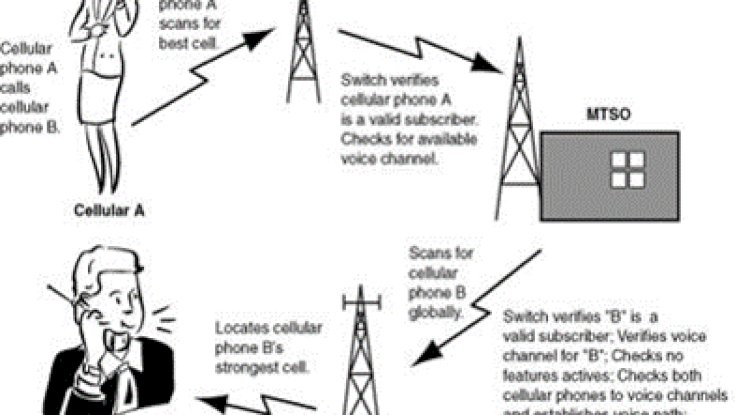
Early cell phone technology used an analogue system called AMPS. This was first generation or 1G technology. After 2008, all cell phones switched to digital. First, let’s see what an analogue signal is. Any sound travels in the form of waves. An analogue signal transmits the sound exactly as it is, without any change. However, when it travels through the air, the sound loses its original quality on its way to the receiver. In analogue cell phones, separated frequencies are used for each conversation – one to receive and one to transmit. Each pair of frequencies is called a ‘channel’. The number of frequencies is limited by the bandwidth. Analogue phone systems can handle only a small number of calls on one frequency or channel. Analog cell phone systems don’t use all the available bandwidth, which leads to wastage. The quality of sound is also poor, with a lot of static, call drops and fading. This method of sending voice based on frequency difference is called frequency modulation; FM channels on the radio also use the same method.
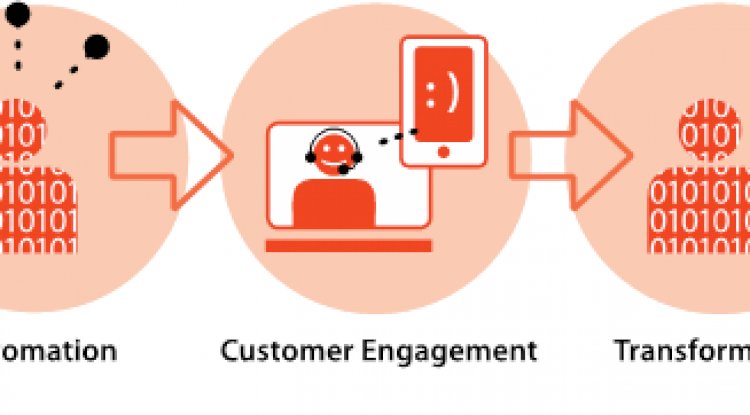
In the digital system, the sound wave is converted into digits or numbers – the binary 1 and 0. Thus, the radio wave is transmitted as a series of numbers. The numbers are converted back to voice at the other end. The audio quality is much better as compared to an analogue signal. Nowadays, all cell phone systems use digital technology also called second generation or 2G. since the data is compressed, much more data can be transmitted on a digital signal – 3 – 10 calls in the space of a single analogue call.
Digital technology has made it possible to send and receive huge amounts of data on cell phones, enabling fast web browsing. You can send and receive emails and surf the internet. It is even possible to have a conversation on live video! You can pay your bills, check your bank account and book tickets using your cell phones! You can use the phone to connect remotely to electronic appliances at home, like recording your favourite TV programmes! Cell phones are becoming more and more sophisticated, with lots of applications (apps) and features. Such are the wonders of cell phone technology and radio waves make it all possible!
What's Your Reaction?