Is earth the only planet to have a life?
There are approximately 200-400 billion stars in our Milky Way galaxy and it is said that there are not less than 100 billion galaxies in the whole universe. However, we have not come across living organisms on any of the planets revolving around other stars. Is it only Earth that has life or is there life anywhere else in the Universe? For a long time, human beings have been searching for life on planets other than the Earth in the Universe. Many people feel that there must be extraterrestrial life.
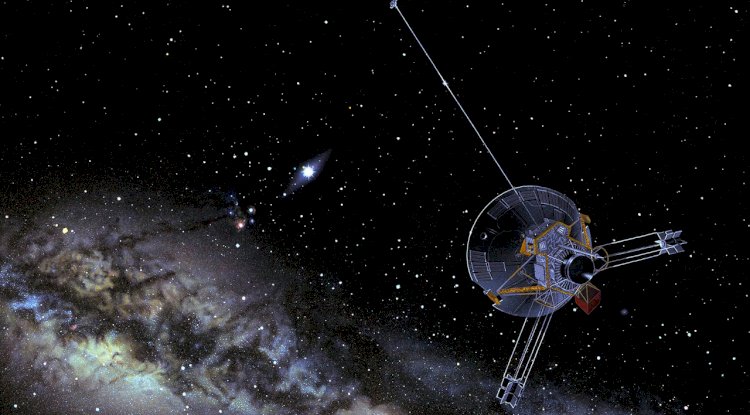
In 1972-73, the USA’s NASA launched Pioneer 10 & 11 respectively, to explore the outer planets of our solar system for signs of life. For a very long time, scientists, mathematicians and philosophers have believed in the possibility of beings on other planets, with more advanced civilisations than ours!
Alien life was thought possible on our moon, the other planets of our solar system and their moons. People zeroed in on Mars as the most likely planet to harbour life, because it was very similar to Earth. American astronomer Percival Lowell devoted his life to the study of Mars. Till the end of his days, he believed that there was water on the red planet as also intelligent life!
In 1878, Italian astronomer Giovanni Schiaparelli observed long, crisscrossing structures on Mars which he called ‘Canali” in Italian. It was mistakenly translated as ‘canals’ in English giving rise to the notion that there was water on Mars! In 1976, NASA sent probes called Viking I and II which landed on Mars, the first spacecraft to do so. The probes analysed the soil and concluded that there were no living organisms on the planet. Though it was later proved that there was no intelligent life on Mars, people continued to believe in Martians! It gave rise to popular science fiction about aliens like H. G. Wells and Wars of the Worlds.
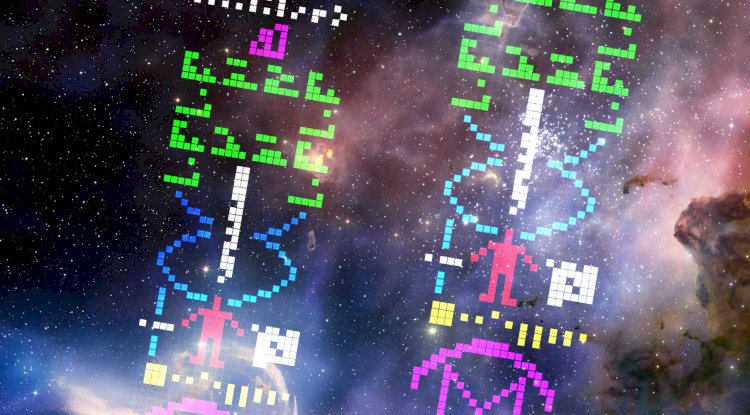
But people were not ready to give up so soon! The search for Extraterrestrial Intelligence or SETI was a programme that devoted itself to looking for alien intelligence by monitoring radio waves from space through radio antennae and radio telescopes. In 1960, SETI’s Project Ozma used a radio telescope not only did astronomers listen for signals from space, but they also sent out signals in the hope that aliens would be listening! The Arecibo message was sent in 1974 from the Arecibo Radio Telescope in Puerto Rico by astronomers Frank Drake and Carl Sagan. The message was aimed at a globular star cluster called M13, which was 25,000 light-years away. This meant that it would take a total of 50,000 light-years for the message to reach and for any reply to travel back!
A light-year is the distance a light wave or a radio wave would travel in one year. The message was sent to M13 because it was the closest and largest cluster available at that place and moment. In any case, by the time the radio waves reached the cluster, the stars in it would have moved position. Radio and TV programmes were also transmitted into space. Till today, there has been no communication from extraterrestrials. However, scientists feel that by studying the Universe, the origins of life on Earth can be understood better. Let's try and find out what is necessary for life to develop. Life on Earth is possible only because of the existence of water and an atmosphere that enables us to breathe.
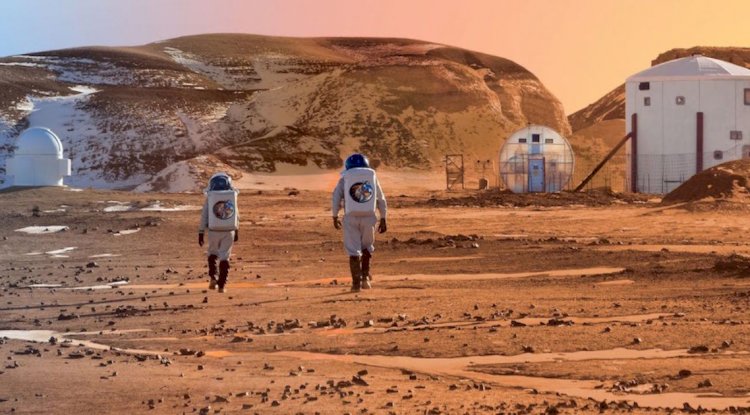
The most Earth-like planet in our solar system is, of course, Mars. Mars is Earth's neighbour, but since it is further away from the Sun, it is much, much colder. The temperatures on both Venus and Mars range from 20°C to 140°C, depending on the seasons’ Venus, Earth's neighbour on the other side, is closer to the Sun, so it is much, much hotter. So now you see how important it is to be at the right distance from the Sun for life to evolve! Mars's atmosphere has less carbon dioxide However, it is believed to have had water millions of years ago. At least one other planet in our solar system is believed to have the possibility of life.
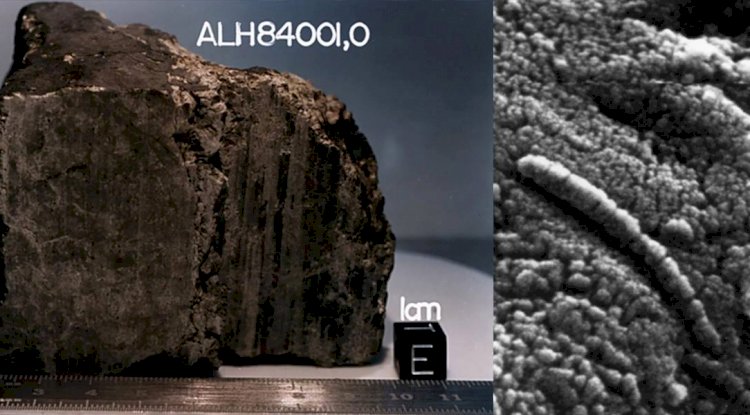
ALH 84001 is a meteorite that was found in Allan Hills, Antarctica on December 27, 1984. Weighing almost 2 kilos, ALH 84001 is thought to have landed on Earth from Mars. But it was unlike any of the other meteorites found till then. ALH 84001 made waves in 1996 when scientists announced that microscopic fossils of possibly Martian bacteria were found in it. The fossilised nanobacteria were believed to have existed when Mars had water 4 billion years ago! Then is Mars the only other planet in our solar system, besides Earth, to have a life? Unfortunately, there has been no concrete evidence of this till now.
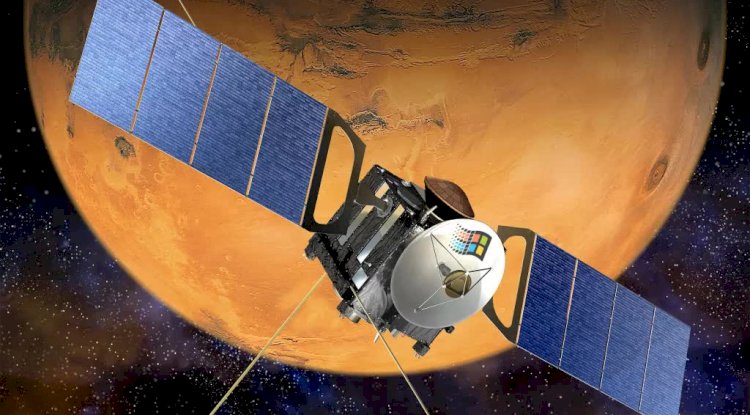
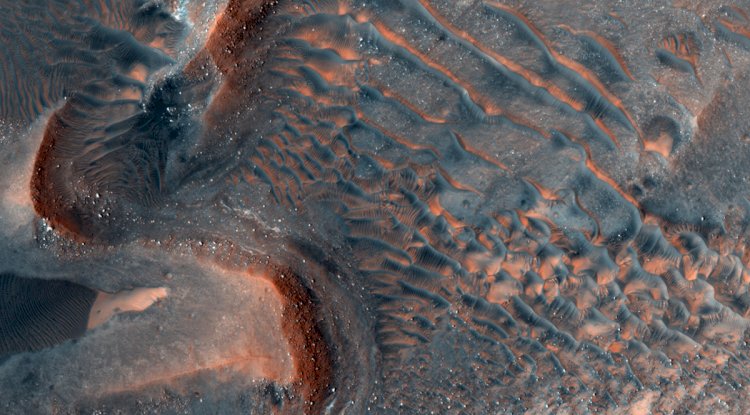
Several unmanned space probes have been sent to Mars starting from the 1960s. We know more about it than any other planet. The American space organisation NASA has sent the maximum number of probes to the Mariner and Viking missions, the Mars Global Surveyors and Polar Landers, the Mars Odyssey and Express orbiters and the Spirit and Opportunity rovers. The latest is the Mars Reconnaissance Orbiter and Curiosity rover. Millions of images of the Mars surface and chemical analyses of its soil and rocks have been sent to Earth by these orbiters, landers and rovers. The Reconnaissance Orbiter found evidence of warm water flows on the hills in the southern region of Mars The rocks on Mars are round, which may be because of erosion by water. If these are recent flows, then there may be a chance of finding some bacterial or microbial life. There might be water trapped underground as well. Long-living bacteria may be discovered trapped in a frozen state. Since Mars is exposed to massive solar radiation, some of the life may have gone deep underground to survive.
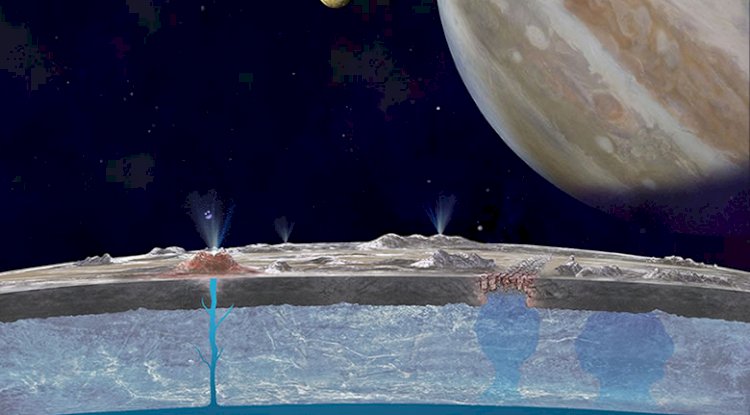
NASA's spacecraft Galileo took pictures of Europa which showed what looked like patches of thick ice with veins of melted water below its surface. There are plans to send orbiters and landers to Europa...(Jupiter) to measure the thickness of the ice crust and check if there is water underneath. It looked as if there was water under the ice. Even if there were underwater volcanoes and thermal vents, there too, life could exist. But as both Europa and its planet Jupiter are very distant from the Sun, it is extremely cold. Life, as found on Earth, would be impossible. If anything does exist, it will be very primitive.
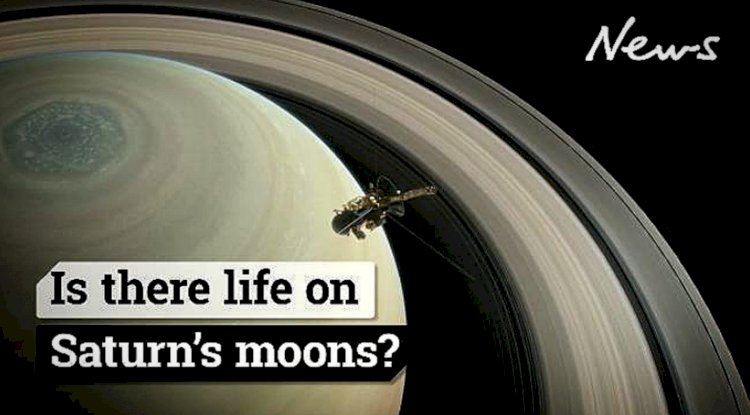
The NASA mission to Saturn, Cassini, launched in 1997, discovered thick clouds of nitrogen covering Titan. Titan has the densest atmosphere of all the moons in our solar system. Titan's atmosphere contains mostly nitrogen, like Earth's and the atmospheric pressure is 1.5 times that of Earth. The conditions on Titan resemble those when Earth was being formed. There are lakes and seas probably made of liquid hydrocarbons like ethane and methane. Methane is colourless and odourless at normal Temperatures and is mainly used as raw material for fuels. Possibly, there is also water vapour in Titan's atmosphere. The Cassini spacecraft, which began orbiting Saturn in 2004, has provided detailed images of and information about Saturn and Titan. Cassini landed a probe called Huygens on Titan in 2005, Astronomers have been searching for Earth-like planets outside our solar system. These are called extrasolar planets or exoplanets. Are there any exoplanets with ideal conditions for life, like Earth? Yes! Very powerful telescopes are making discoveries every year!
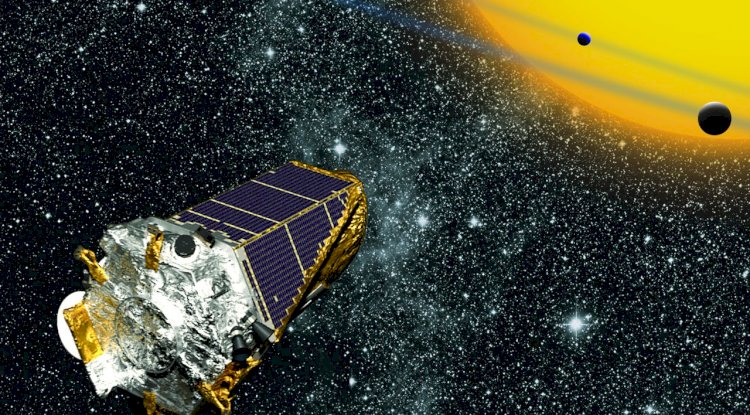
NASA's Kepler space telescope has identified more than 1,200 planets in orbit around distant stars Fifty-four of these are similar to Earth in size and at an ideal distance from their suns In previous years, too, exoplanets have been found. For example, a planet was discovered in the Pegasus constellation which is 45 light-years away. in 1995. Planets have also been found orbiting stars in the Andromeda and Epsilon constellations in an exciting discovery much closer to home, researchers found a microbe at the bottom of Mono Lake in Yosemite National Park that was thriving in water laden with arsenic, a deadly poison. Scientists speculate that similar life forms could exist on planets with extreme conditions. With so many new planets being discovered... Yes, though we haven't yet come across alien civilisations, the Universe may well be teeming with life!
What's Your Reaction?